
Information Center
What is the experience of living in a green ultra-low-energy house? The news media takes you into the first high-standard house in the sub-center.
Recently, reporters from Beijing Television and the Beijing News visited the Tongzhou Guoyu Future Joy Project, the first batch of high-standard residential buildings and ultra-low-energy buildings in Beijing undertaken by Beijing Urban Construction North Group, and carried out key reports, which attracted widespread attention from the society.
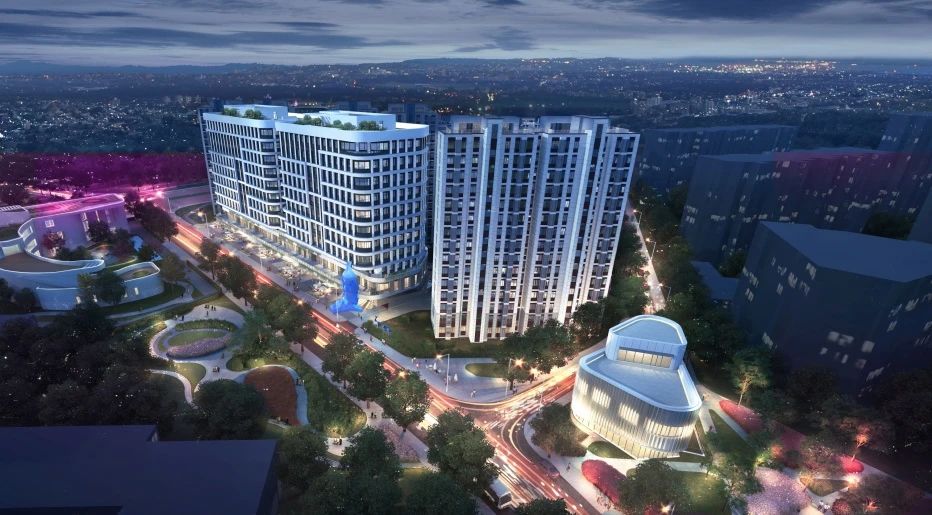
On June 26, Beijing issued a new provident fund policy, clarifying that for the families of paid-in workers who purchase two-star and above green buildings, prefabricated buildings or ultra-low energy consumption buildings, they will be supported by the floating loan amount, with a maximum loan amount of 1.6 million yuan. What is the experience of staying in a green, ultra-low energy building? After the release of the new policy, the Beijing News reporter visited the Guoyu Future Joy Project in Tongzhou District, which is the first batch of high-standard residential buildings in Beijing and the first in the sub-center, which integrates a number of livable technologies such as green buildings, healthy buildings, prefabricated buildings, and ultra-low energy buildings.
The indoor is warm in winter and cool in summer, and the assembled wallboard can be flexibly disassembled and modified.
Reporters walked into Guoyu Future Yue. The main structure of buildings has been completed and facade construction and interior decoration are underway. According to Yang Xu, project manager of Tongzhou Guoyu Future Yue Project of Beijing Urban Construction North Group, the total construction area of Guoyu Future Yue Project is about 81512.16 square meters, including residential buildings, supporting public buildings, commerce and kindergartens. As the first batch of high-standard residential projects in Beijing, Guoyu Future Yue has applied a number of livable technologies such as green buildings, healthy buildings, prefabricated buildings, and ultra-low energy buildings.
"The assembly rate of the house is 93%, and the residential and public parts are all designed with ultra-low energy consumption. Although the house is also equipped with a fresh air system and underfloor heating system to meet the actual needs of different owners, for the owners, after moving in, they can feel warm in winter and cool in summer without having to turn on the air conditioning and underfloor heating." Yang Xu said.
The reporter walked into a model room, the interior space layout and decoration seem to be the same as ordinary houses, but in fact, "hidden mystery". "The interior decoration, pipelines and structures of the house are separated, and the walls of the room are made of prefabricated wall panels, which reserve a large space for the owners to demolish and modify. The owners can design the layout of the room according to their own preferences and needs." Beijing Urban Construction North Group Tongzhou Guoyu Future Yue Project Chief Engineer Zhang Xinyu introduced.
The project adopts nine scientific and technological systems of constant temperature, constant static, constant oxygen, constant cleaning, water purification, light control, assembled decoration, intelligence and energy saving, which can ensure a quiet, comfortable and healthy life indoors. At the time of the interview, the outdoor construction work was underway, the window was opened, the noise was obvious, the window was closed, and the indoor was instantly silent.
After the project is put into use, the average annual carbon dioxide emission reduction is about 3000
We use high-efficiency heat recovery fresh air system, renewable energy system, solar photovoltaic power generation and air source heat pump system, greatly increasing the proportion of renewable energy applications. Household independent set of total heat exchange fan, can make the equipment in the state of low energy consumption to maintain a comfortable indoor environment." Yang Xu introduced.
The project uses renewable resources rationally, designs a photovoltaic power generation system on the roof, and converts solar energy into electrical energy through solar photovoltaic for the building itself. The total photovoltaic area of the project is about 3780 square meters, which is 40% of the roof area. The annual power generation is about 680000 kWh, and the annual carbon emission reduction is about 410 tons.
According to the plan, the project will be completed by the end of this year. It is estimated that after the project is put into use, the average annual carbon dioxide emission reduction can reach about 3000 tons. It is reported that at present, the residential buildings in Beijing implement the 80% building energy-saving design standard, the residential energy-saving rate of the project can reach more than 90%, and the building energy-saving level has been newly improved.
For the purchase of green ultra-low energy consumption buildings, the maximum loan amount of provident fund reaches 1.6 million yuan.
According to the statistics of the World Resources Institute, China's carbon emissions mainly come from electricity, construction, industrial production, transportation, agriculture and other fields, of which construction accounts for more than 20%, ranked second. With the continuous development of economy and science and technology, the construction industry has changed from the traditional extensive development to the coordinated development of intelligent construction and construction industrialization, gradually moving towards green and low-carbon development, and realizing the transformation of industrialization has become inevitable.
In recent years, the Ministry of Housing and Urban-Rural Development has required the construction industry to continue to work on industrialization, digitalization, and green transformation. Beijing is also vigorously promoting the application of new technologies such as prefabricated buildings, green buildings, and ultra-low energy buildings.
On June 26, in order to promote the development of green buildings, Beijing introduced a housing provident fund support policy. That is, for borrowers who purchase two-star and three-star green buildings, the loan amount can be increased by 200000 yuan and 300000 yuan respectively. Borrowers who purchase A(BJ), AA(BJ) and AAA(BJ) prefabricated buildings can increase the loan amount by 100000 yuan, 200000 yuan and 300000 yuan respectively. Borrowers who buy ultra-low energy buildings can borrow up to 400000 yuan. The New Deal limits the maximum amount. For borrowers who meet the above-mentioned applicable conditions at the same time, the floating amount can be accumulated, up to 400000 yuan, and the maximum loan amount does not exceed 1.6 million yuan.

Contact Phone:010-89411887
Zip Code: 101399
Company address: Building 2, Yard 4, Yuzhuang South Street, Gaoliying Town, Shunyi District, Beijing
版权所有:Beijing Urban Construction North Group
Friendship Link
National Development and Reform Commission of the People's Republic of China | State Administration of Work Safety | Ministry of Housing and Urban-Rural Development of the People's Republic of China | Beijing Municipal Commission of Development and Reform | Beijing Municipal Administration of Work Safety | Beijing Municipal Commission of Housing and Urban-Rural Development | Beijing Municipal Bureau of Human Resources and Social Security | Beijing Municipal Bureau of State Administration of Taxation | Beijing Urban Construction Group | Beijing Urban Construction North Deyuan Real Estate