
Information Center
The "Technical Regulations for Safety Selection of Socket-type Pan-buckle Steel Pipe Scaffold" edited by the Group will be implemented from July 1.
The Beijing-Tianjin-Hebei collaborative standard "Technical Regulations for Safety Selection of Socket Plate-type Steel Pipe Scaffold" (DB11/T 2100-2023)(hereinafter referred to as "Regulations") jointly compiled by 6 editor-in-chief units including Beijing Urban Construction North Group, China Construction Sixth Engineering Bureau Company and more than 20 participating units will be formally implemented on July 1, which has important guiding significance for improving the construction technology level and coordinated development of Beijing-Tianjin-Tianjin-Hebei.
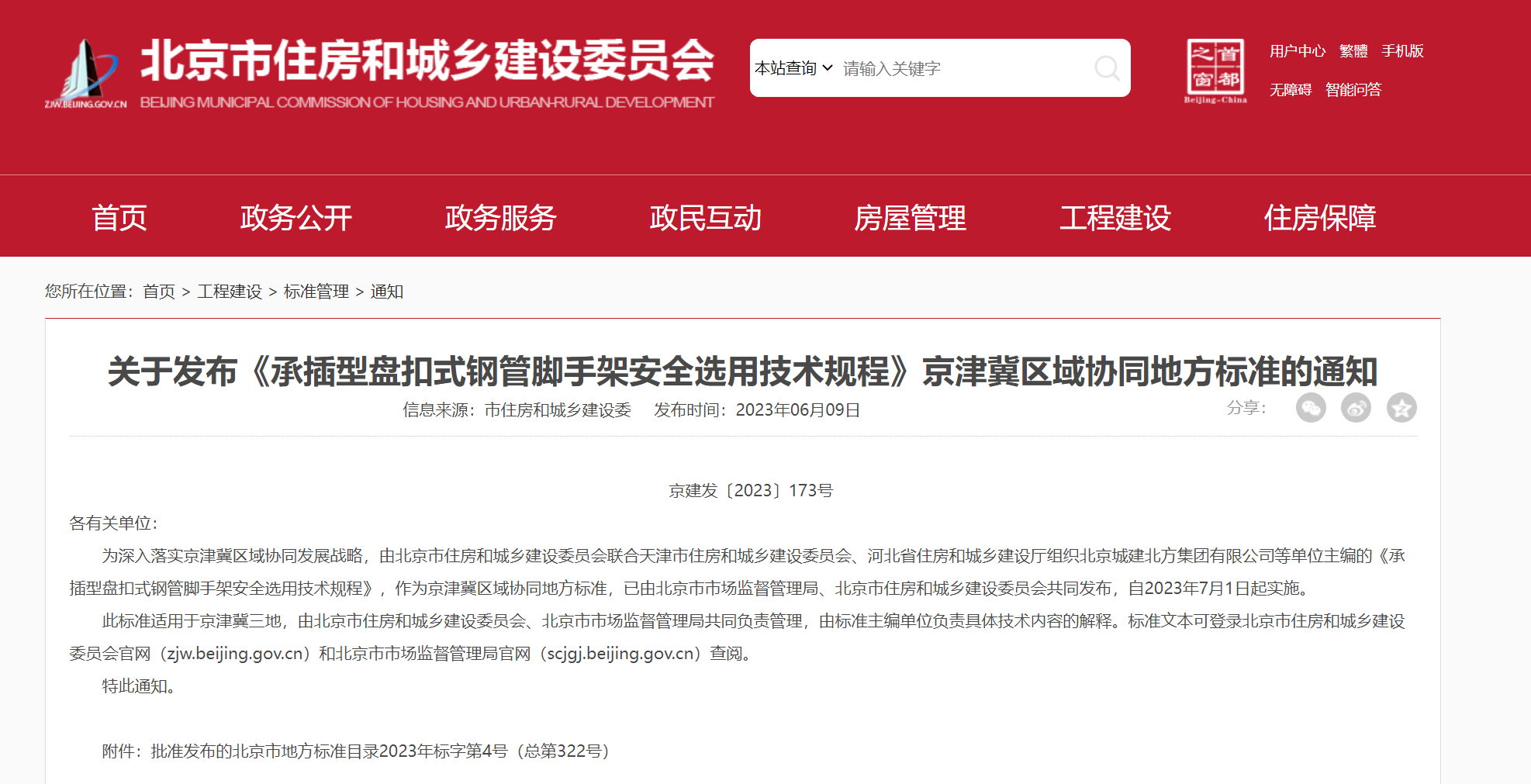
This "Regulation" is the first local standard independently compiled by the Group. Since the establishment of the project in 2018, the compilation team has extensively investigated the current situation of the use of socket-type buckle-type steel pipe scaffold in the Beijing-Tianjin-Hebei region, carefully summarized practical experience, carried out a large number of theoretical research, calculation and experimental verification, and compiled it after four years on the basis of extensive solicitation of opinions.
The "Regulations" innovatively put forward the selection conditions and erection parameters of the socket-type pan-buckle steel pipe scaffold. For the first time, the detailed node structure such as pole connection form, base assembly and joist is defined. At the same time, the installation and removal, use and management of socket-type pan-buckle steel pipe scaffold are stipulated.
The Regulations specify the selection conditions and erection parameters of double-row scaffolding, full-hall scaffolding and support frames, and projects that meet the conditions can be directly selected, simplifying the design and calculation of the frame body and facilitating the use of engineering and technical personnel of construction enterprises. The corresponding requirements are put forward for the key parts such as the setting of the scaffold diagonal rod and the bracing, the node and design calculation of the joist under the beam, the erection of the support frame at the post-pouring belt part, and the erection of the steel scaffold board, which can be used to guide and standardize the on-site construction. Combined with the assembly building truss reinforced concrete composite slab, the design calculation and construction requirements of the support frame are put forward for the first time, which can promote the popularization and application of the socket-type disc-type steel pipe scaffold in the assembly building.
Up to now, the group has presided over and participated in the formulation of a total of 39 national, industry, local and group standards, of which 27 have been released. In the field of scaffolding construction, in addition to this "Regulations", it also participated in the preparation of the national standard "General Specification for Construction Scaffolding" and the industry standard "Safety Protection Platform for Attached Lifting Operation for Building Construction", and edited a number of local standards such as "Technical Standards for Safety Selection of Attached Lifting Scaffolds" and "Technical Regulations for Safety Selection of Fastener and Bowl Steel Pipe Scaffolds.
In the future key development areas such as smart construction, prefabricated buildings, green and low-carbon, participated in the compilation of many local standards such as "Technical Regulations for Smart Sites", "Evaluation Standards for Smart Sites", "Technical Specifications for Construction Safety of Prefabricated Buildings", "Fineness Standards for Construction Process Models of Cast-in-situ Concrete Structure Engineering and Masonry Structure Engineering", "Technical Regulations for Application of Recycled Masonry Materials for Construction Waste" and other group standards, help enterprises to transform and upgrade, and promote the Group's intelligent construction, green low-carbon environmental protection work to further enhance.

Contact Phone:010-89411887
Zip Code: 101399
Company address: Building 2, Yard 4, Yuzhuang South Street, Gaoliying Town, Shunyi District, Beijing
版权所有:Beijing Urban Construction North Group
Friendship Link
National Development and Reform Commission of the People's Republic of China | State Administration of Work Safety | Ministry of Housing and Urban-Rural Development of the People's Republic of China | Beijing Municipal Commission of Development and Reform | Beijing Municipal Administration of Work Safety | Beijing Municipal Commission of Housing and Urban-Rural Development | Beijing Municipal Bureau of Human Resources and Social Security | Beijing Municipal Bureau of State Administration of Taxation | Beijing Urban Construction Group | Beijing Urban Construction North Deyuan Real Estate